


Official Website of the
Catholic Diocese of Little Rock
History of the Diocese of Little Rock
Updated Sept. 16, 2026
Overview

Bishops Andrew J. McDonald, Anthony B. Taylor
and J. Peter Sartain pose for a photo prior to
Bishop Taylor's ordination and installation as the
diocese's seventh bishop on June 5, 2008.
The history of the Catholic Church in Arkansas has reflected how a relative few can affect the many. Missionary priests introduced Christianity in the 16th century. Nearly 300 years later, a religious order of nuns opened the first school in a newly minted state. The Diocese of Little Rock worked from its inception to build colleges, hospitals, churches and help settle the Arkansas River Valley. All this when Catholics accounted for less than 2 percent of the population.
In the 20th century, the Church shepherded its congregation through two world wars followed by decades of seismic social and theological change. The diocese opened a seminary in the early 1900s to train priests, closed it in the turbulent ‘60s and now struggles with a dearth of religious vocations. Political refugees and immigrants swelled parish rolls, beginning in the 1970s. The diocese adapted to its shifting demographics by opening new ministries, ordaining deacons, and activating the laity to further the causes of peace, justice and a respect for life.
Pre-History: 1541-1836
A dozen Catholic priests accompanied Spanish explorer Hernando de Soto down the Mississippi River in 1541 to a Quapaw Indian village near present-day Helena-West Helena, where they lifted a cross and sang praise to God. This marked the first Christian ceremony within the future boundaries of Arkansas.
In 1682, French explorer Rene-Robert Cavelier, Sieur de La Salle claimed the territory for a Catholic king, Louis XIV of France. A La Salle lieutenant, Italian-born Henri de Tonti, established Arkansas Post at the mouth of the Arkansas River but scrapped plans for a Jesuit chapel and mission house after battles with the Indians.
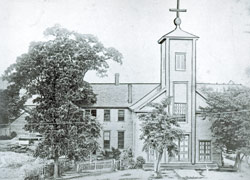
The first Cathedral of St. Andrew (above), at Second
and Center streets in Little Rock, was consecrated
in November 1846. The second Cathedral, was built
across the street from the original and was
consecrated in 1881. It remains the oldest church
(of continuing worship) in the city of Little Rock.
Father Jacques Gravier, a Jesuit priest, celebrated the first Catholic Mass in a Quapaw village on Nov. 1, 1700. St. Mary Church was built at Arkansas Post in the late 1700s. It is believed to be the first Catholic church built in Arkansas. After the United States acquired the Arkansas territory in the Louisiana Purchase of 1803, newcomers arrived from Europe, Africa and older Southern states. Most were Protestant. Father Ennemond Dupuy built a new St. Mary Church along the Arkansas River, downstream from Pine Bluff, in 1832.
He was the only priest living in Arkansas upon statehood in 1836. The Sisters of Loretto opened St. Mary's Academy, the first Catholic school in Arkansas, at the parish in 1838. Because of continual problems with flooding, St. Mary Church was moved to its present location in Plum Bayou in 1869.
A Fledgling Diocese: 1836-1867
Pope Gregory XVI established the Diocese of Little Rock on Nov. 28, 1843. His appointed bishop, Andrew J. Byrne, was consecrated March 10, 1844, in New York and rode into Little Rock on horseback June 4. The Irish-born bishop found a scattered Catholic population of about 700. The Cathedral of St. Andrew in Little Rock was consecrated on Nov 1, 1846. The bishop persuaded an Irish order of nuns, the Sisters of Mercy, to come to Little Rock, where they founded Mount St. Mary Academy in 1851.
The bishop battled a wave of anti-Catholic. The church in Helena was burned in 1854. As the country edged closer to Civil War, soldiers occupied diocesan property in Fort Smith. Bishop Byrne died June 10, 1862, in Helena. Arkansas remained a sede vacante (vacant see) for nearly five years. A new bishop was not appointed until 1867.
Post-War Rebuilding: 1867-1906
Edward M. Fitzgerald, another Irishman, came to Arkansas by steamboat after his consecration as the second bishop of Little Rock on Feb. 3, 1867, in Columbus, Ohio. At age 33, the nation’s youngest prelate rebuilt churches and mission stations damaged by the Civil War. While in Rome for the First Vatican Council of 1869-1870, Bishop Fitzgerald publicly opposed the doctrine of papal infallibility, which states the pope is always correct when he speaks ex cathedra on church doctrine. The young bishop explained that to vote otherwise would have hampered evangelization efforts in Arkansas, where there were fewer than 2,000 Catholics.
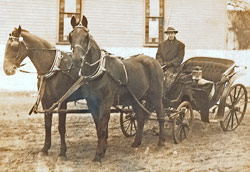
Bishop Edward Fitzgerald
The cornerstone for the second Cathedral of St. Andrew was set July 7, 1878, at Seventh and Louisiana in Little Rock. An English gothic structure arose as the first building constructed of Arkansas granite, hauled in from the Fourche Mountains. The Cathedral was consecrated on the first Sunday of Advent in November 1881.
In 1884, Bishop Fitzgerald attended the Third Plenary Council in Baltimore, where he heard the call for U.S. bishops to build a Catholic school in every parish. Bishop Fitzgerald, at his Silver Jubilee in 1892, could point to 31 schools and 58 churches either built or under construction. The Catholic population approached 10,000, with 32 priests. Much progress owed to the bishop’s business acumen. He worked with the Little Rock and Fort Smith Railroad Company to award land to settlers from Germany, Italy, Poland and Switzerland. The railroad donated 640 acres in Logan County to the Benedictine fathers who built St. Benedict’s Priory, now Subiaco Abbey.
Religious orders opened four hospitals around the turn of the century. In 1888, the Sisters of Charity founded Charity Hospital (now CHI St. Vincent Infirmary) in Little Rock and the Sisters of Mercy opened St. Joseph’s Hospital in Hot Springs (now CHI St. Vincent Hot Springs). The Olivetan Benedictine Sisters established St. Bernard Hospital in Jonesboro in 1900, amid a yellow fever epidemic. In 1905, the Sisters of Mercy named their new Fort Smith hospital St. Edward’s to honor Bishop Fitzgerald, who lay paralyzed by a stroke. The bishop died Feb. 21, 1907, in Hot Springs.
Building on Faith: 1906-1946
The third bishop of Little Rock, John B. Morris of Tennessee, had been appointed diocesan coadjutor in 1906 and took office immediately upon the death of Bishop Fitzgerald. He continued mission work among black Arkansans, establishing black Catholic parishes in Little Rock, North Little Rock, El Dorado, Fort Smith, Helena, Hot Springs and Lake Village.
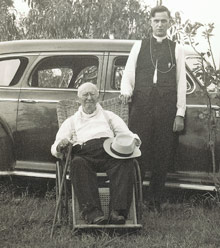
Bishop John B. Morris and Bishop Albert
L. Fletcher in the early 1940s.
Bishop Morris extended diocesan support to the disadvantaged. He founded St. Joseph’s Orphanage in North Little Rock, entrusting the children to Benedictine sisters; the Morris School for Boys in Searcy to the Franciscan brothers; and St. Michael in Hot Springs, a school for wayward girls, to the Sisters of Our Lady of Charity and Refuge. Bishop Morris opened St. John Home Missions Seminary, at 25th and State streets in Little Rock, with 10 students and four priest-teachers on the Little Rock College campus in 1911 with St. John the Baptist as its patron.
In its first 12 years, the seminary trained 45 priests, including 38 for its home diocese. After outgrowing its buildings, from 1916 to 1920, Little Rock College and St. John Seminary moved to a new campus in the Pulaski Heights area of Little Rock. It was located on 40 acres bordering the city limits. In 1920 the seminary separated from the college and moved back to the buildings downtown. In 1929, following the economic depression, Bishop Morris announced he was closing Little Rock College and moving the seminary back to the Heights. The old seminary building then became home to the new Catholic High School for Boys.
By 1940, more than 33,000 Catholics attended 125 churches in Arkansas. The state’s 141 priests included 59 native-born. One, Albert L. Fletcher, was appointed auxiliary bishop in 1940. Bishop Morris died Oct. 22, 1946, in Little Rock.
Race, Vatican II and Vietnam: 1947-1972
The first Arkansan raised to the Catholic Church hierarchy, Bishop Fletcher became the fourth bishop of Little Rock on Feb. 11, 1947. His quarter century of service spanned canonical and social change that shook the Church and the world.
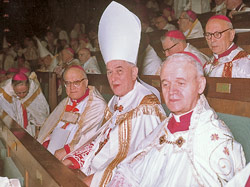
Bishop Albert Fletcher (second from right) at the
Second Vatican Council in Rome.
The civil rights movement led to the closing of most black Catholic churches in Arkansas over a 12-year period, beginning in 1954 when the U.S. Supreme Court outlawed segregated schools. After the Arkansas National Guard blocked nine black students from entering Little Rock Central High School in 1957, Bishop Fletcher wrote in the diocesan newspaper that it was wrong to interfere with peaceful integration. By 1962, Catholic High and Mount St. Mary began enrolling black students.
From 1962 through 1965, Bishop Fletcher attended fall sessions of the Second Vatican Council. For Arkansas Catholics, the most noticeable change arising from Vatican II happened the first Sunday of Advent in 1964 when the priest faced the people to celebrate Mass in English.
In the latter part of the 1960s, Bishop Fletcher split with young priests teaching at St. John seminary on social and theological questions, including birth control and papal infallibility. After a seminary priest wrote a series of newspaper articles critical of Catholic doctrine, the seminary closed in 1967. In 1968, the former seminary campus was renamed St. John Catholic Center and became the home of the Diocese of Little Rock offices. In July 1972, the Vatican accepted the resignation of Bishop Fletcher, who had reached the mandatory retirement age of 75. He died Dec. 6, 1979, in Little Rock.
The Church in Action: 1972-2000
Andrew J. McDonald of Savannah, Ga., became the fifth bishop of Little Rock on Sept. 5, 1972. Three months later, the church in Arkansas, home to more than 55,000 Catholics, was reassigned from New Orleans (where it had been part of the Southern province since 1850) to the archbishopric of Oklahoma City.
Social action defined Bishop McDonald’s tenure. Church offices emerged to serve a rapidly growing Hispanic population and to welcome political refugees from Vietnam, Cuba and Central and South America. The diocesan Office of Justice and Peace championed fair treatment at home for people lacking food, adequate housing and other necessities while joining an international push for nuclear disarmament.
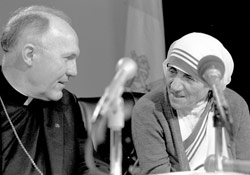
Bishop Andrew J. McDonald talks with Mother
Teresa of Calcutta at a rally at Ray Winder Field in
Little Rock, June 3, 1982.
The U.S. Supreme Court decision released Jan. 22, 1973, legalizing abortion triggered an immediate protest from Bishop McDonald in words and action.
Mother Teresa of Calcutta (now St. Teresa of Calcutta) visited Little Rock in 1982 to consider taking over the operation of Abba House, a shelter for pregnant mothers, their children and homeless women. She agreed and the Missionaries of Charity sisters arrived in 1983 to run the home. During her visit, Mother Teresa spoke at a rally at Ray Winder Field, attended by more than 5,400 people, making it the second largest Catholic assembly in Arkansas history.
An active laity found purpose in myriad programs. A local couple developed the now widely distributed Little Rock Scripture Study program to deepen an appreciation and understanding of the Bible. RENEW helped unify parishes through small-group sharing. Cursillo weekends strengthened friendships in a spirit of community. Couples participated in Pre-Cana programs to prepare for marriage, Marriage Encounter retreats to strengthen relationships and Retrovaille sessions to heal them. By 1993, the Catholic population exceeded 75,000, but the decrease in vocations to the priesthood and religious life had accelerated. Bishop McDonald, as required by age, submitted his resignation in 1998 and formally retired Jan. 4, 2000.
A Second Language: 2000-2008
A crowd of 2,600 saw J. Peter Sartain of Memphis installed as the sixth bishop of Little Rock on March 6, 2000. Under his leadership, the Church intensified its Hispanic ministry. The bishop took Spanish lessons and dedicated Hispanic-led parishes in southwest Arkansas. He also pushed for more priestly vocations. In 2005 he led 5,000 Catholics in a daylong Eucharistic Congress in Little Rock.
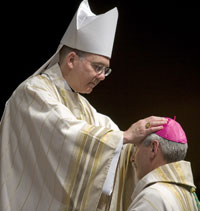
Bishop J. Peter Sartain lays hands
on newly ordained Bishop Anthony
B. Taylor at his ordination and
installation June 5, 2008.
A gifted writer and powerful speaker, Bishop Sartain held national offices within the U.S. Conference of Bishops. His appointment May 16, 2006, as bishop of Joilet, though sudden, was not surprising. The Catholic population of Arkansas approaches 113,000, with much of the growth in western sections where Mexican-born laborers work in poultry plants. Elsewhere, a lack of students forced the closing of four Catholic elementary schools from 2001 to 2007, in Blytheville, El Dorado, Hot Springs and Little Rock.
Msgr. J. Gaston Hebert was appointed administrator June 29, 2006, of a diocese left sede vacante, without a bishop. Since that time, the diocese has enjoyed an increase in seminarians, particularly ones from other countries. In October 2007, for the first time in the diocese’s history, a formal declaration of excommunication was issued by the Catholic Church for six nuns in Hot Springs. The Monastery of Our Lady of Charity and Refuge sisters received the penalty for their continued involvement in the Community of the Lady of All Nations, also known as the Army of Mary. It is a schismatic association based in Quebec, Canada.
The Internet Age: 2008-2015
Pope Benedict XVI named Father Anthony Basil Taylor, of the Archdiocese of Oklahoma City, the seventh bishop of the diocese April 10, 2008. Bishop Taylor, 54, was ordained at the Statehouse Convention Center in Little Rock on June 5, 2008. Bishop Taylor became the first American Catholic bishop to join Facebook.
In the same month, he accepted 50 men to begin diaconate formation, making it the largest class in the history of the diocese, a plan that had been set in motion by Diocesan Administrator Msgr. Hebert. In November, Bishop Taylor issued his first pastoral letter, “I Was a Stranger and You Welcomed Me: A Pastoral Letter on the Human Rights of Immigrants.” In the bilingual document, he said immigration reform should begin with protecting the human rights of all immigrants, regardless of their legal status.
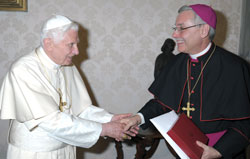
Bishop Taylor greets Pope Benedict XVI during his
first "ad limina" visit March 16, 2012.
In 2009, Bishop Taylor spoke out against anti-immigrant legislation and in favor of health care reform. He reorganized the diocese's deaneries, launched a pastoral planning process, established a special collection for diocesan seminarians and sent priests to learn Spanish.
"Gospel Without Borders," a documentary that explores the issue of immigration from a faith-based perspective, was released in August 2011. It features an interview with Bishop Taylor and footage from St. Peter Church in Pine Bluff. He also launched "Open Your Hearts in Welcome!" an initiative that identified his top four priorities for the Diocese of Little Rock through March 2013, including: 1.) Welcoming the English translation of the New Roman Missal; 2.) Welcoming natural family planning for all engaged couples of child-bearing age; 3.) Welcoming the newcomers in our midst; this includes those joining the Church, immigrants, young adults and retirees new to the state, and those who have left the Church and want to return; 4.) Welcoming the Lord's call in your life, including a possible call to the priesthood.
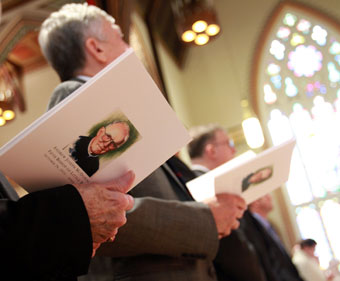
Mourners attend the funeral of Bishop Andrew J. McDonald April 8,
2014 at the Cathedral of St. Andrew in Little Rock.
In March 2012, he blessed the new House of Formation at Our Lady of Good Counsel Church in Little Rock for those discerning the priesthood. That same month, the bishop made his first "ad limina" visit to the Vatican. In 2014, the diocese reached 46 seminarians, the highest number since 1965 when the diocese operated St. John Home Missions Seminary in Little Rock. It was a 61-percent increase over the past decade.
On April 1, 2014, the diocese said goodbye to Bishop Emeritus Andrew Joseph McDonald, who was 90 years old. During his 28 years as bishop of Little Rock, he instituted the Mass for Life, helped the faithful adjust after the Second Vatican Council and invited Mother Teresa of Calcutta to Little Rock. A staunch defender of pro-life causes, Bishop McDonald was known for always wearing a tiny feet pin and speaking out often about why abortion and the death penalty are morally wrong.
During the Year of Consecrated Life, which was held Nov. 30, 2014 to Feb. 2, 2016, several Arkansas religious orders hosted tours, retreats, celebrated Masses and educated the faithful about religious life. Fitting for the Year of Consecrated Life, Father Leonard Wangler, OSB, was elected the seventh abbot of Subiaco Abbey March 24, 2015 after Abbot Jerome Kodell stepped down after 25 years of leadership. The Arkansas Religious Freedom Restoration Act became law April 2, 2015. It was enacted two months before the U.S. Supreme Court ruled that same-sex unions are recognized as marriages.
Adapting to Changing World: 2016 to Present
Arkansas Catholic, the newspaper for the Diocese of Little Rock, published the following "Year in Review" articles. We invite you to learn more by reading these historical summaries.