

Official Website of the
Catholic Diocese of Little Rock
Solemnity of Our Lord Jesus Christ, King of the Universe 2026
Published: November 22, 2026
Bishop Anthony B. Taylor recorded the following homily to be played at all Masses in Arkansas the weekend of Nov. 21-22, 2026.
Download MP3 file to your device
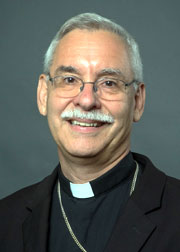
Bishop Taylor
Dear friends in Christ, today we celebrate the feast of Christ the King, and we mark 18 years since the 2008 promulgation of my original pastoral letter on the human rights of immigrants, and today’s roll out of an updated version of that, still very timely, pastoral letter.
Please note that I am doing so only after the recent elections are over to make it clear by its timing that this pastoral letter is about Church teaching and not about politics in what remains a hot issue for many Catholics in our country.
This feast of Christ the King reminds us that we are a nation under God: Give to Caesar what belongs to Caesar but give to God what belongs to God, meaning that God’s claims come first, Christ is king. In today’s Gospel, he says that our eternal destiny depends, in part, on the welcome we give or fail to give the alien in our midst.
Most Americans do not realize the impossible barriers placed on most people who want to enter our country legally, which I explain in the letter. People don’t want to be undocumented; they are present in our country without papers because they have no other choice.
What did Jesus say in the Gospel we just read? “Come ... inherit the kingdom prepared for you from the beginning of the world ... for I was a stranger and you welcomed me” ... ”When did we welcome you away from home?” ... ”As often as you did it for one of my least brothers and sisters, you did it for me.” ...
”Out of my sight, you condemned, into that everlasting fire prepared for the devil and his angels ... for I was away from home and you gave me no welcome” ... ”When did we see you away from home ... and not attend you in your needs?” ... ”As often as you neglected to do it to one of these least ones, you neglected to do it to me.”
These will go off to eternal punishment and the just to eternal life.
You couldn’t ask for a clearer statement from Jesus than that. In my pastoral letter, which will be distributed to everyone as you leave Mass today, I address four basic principles:
- First — The economic principle of supply and demand and the fact that national borders have almost never prevented immigration when there were strong economic reasons for such migration. Expelling 12 million people is not a realistic option historically, economically or socially. Our only real choice is whether we will facilitate this process for the common good or try to create as much misery as possible — and reap the undesirable consequences. Most Americans do not realize the impossible barriers placed on most people who want to enter our country legally, which I explain in the letter. People don’t want to be undocumented; they are present in our country without papers because they have no other choice.
- Second — The moral principle that people have a God-given right to immigrate when circumstances so require. Our Declaration of Independence declares: "We hold these truths to be self-evident, that all men are created equal, that they are endowed by their Creator with certain inalienable rights, that among these are life, liberty and the pursuit of happiness." The right to immigrate derives from our right to life, liberty and the pursuit of happiness. Since they come from God, no government has the authority to deny us these rights or apply them in a selective or discriminatory manner. But on the other hand, unlike the right to life itself, which is absolute, all our other rights are limited by the common good and so there are instances where the common good might prevent or restrict immigration.
- Third — The theological principle of the common good. The common good is the shared good of all residents in our community, our nation, and by extension the entire human family. In this document I address how national borders serve the common good and the implications of undocumented immigration for the rule of law—and what we can do to set things right.
- Fourth — To these three intellectual principles, I add a fourth principle — a spiritual principle — in the accompanying study guide designed to help us now move from our heads down into our hearts, which is where conversion occurs. What Jesus is challenging us to do is to let him share his heart and mind with us. All that I have to say really boils down to Jesus’ call for us to love as he loves, without fear, trusting in God’s providence.
To help you do this, I have two things to offer you:
- 1.) The full text of my pastoral letter which you will be given to take home with you as you leave Church today. I ask you to read not only the text itself, but also the footnotes and appendices, which I think will be eye-openers for many of us.
- 2.) The pastoral letter ends with a link to a study guide intended to be used by all the different groups in our parishes: Prayer groups, youth groups, women’s groups, the Knights of Columbus, OCIA and confirmation classes, Catholic high schools and religious education programs, parish councils and committees and so on.
Advent is a time of longing and expectation, a time of hope. Jesus’ parents found no warm welcome in Bethlehem, no room in the inn. What changes do we need to make here in our nation, in our parishes and in our own hearts in order to ensure that today’s Marys and Josephs — today’s Marías and Josés — receive from us a warm welcome truly worthy of the Savior whose birth we celebrate on Christmas?
One of the constant features of the history of American immigration is the process of conversion whereby the receiving population learns to soften its heart and open its arms to welcome the newcomer.
As we have seen with the earlier waves of immigrants, this process takes time — time for the immigrants to assimilate and time for the receiving population to become comfortable with the newcomers. Yesterday’s immigrants faced many of the same obstacles that now confront immigrants today. We are astonished today to read of the mean-spiritedness of the “Irish need not apply” signs of the 1800s. But we are also edified by the poem by Emma Lazarus on the Statue of Liberty which concludes with the words:
“Give me your tired, your poor,
Your huddled masses yearning to breathe free,
The wretched refuse of your teeming shore.
Send these, the homeless, tempest-tost to me,
I lift my lamp beside the golden door!"
One of the most distinguishing features of our Catholic faith is that we are called to be “universal” in fact as well as in name. This means that there must be no dividing lines within our parishes, no second-class parishioners — all are welcome, no exceptions. But there’s more to it than that. You and I are being offered a unique and privileged opportunity to share the mind and heart of Jesus Christ, the same Jesus whom we honor with so many images of the Sacred Heart, his heart visible, crowned with thorns and on fire with love.
And that’s who he now invites us to be, Christ for others. In this, God will use us to be a not only light to our nation but also more importantly a source of love, love that banishes fear, love that brings hope and healing, and in this way become a model for what all of American society is called to be.