


Official Website of the
Catholic Diocese of Little Rock
The Nativity of the Lord (Christmas) 2025
Published: December 25, 2025
Bishop Anthony B. Taylor preached the following homily Dec. 24, 2025.
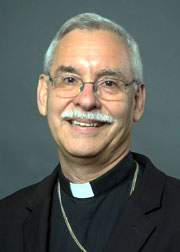
Bishop Taylor
Winter is the darkest time. Three days ago was the Winter Solstice, the shortest day and longest night of the year. The end of six months of ever-lengthening nights.
Winter is when we have the most funerals, the worst epidemics and the most accidents. It is the coldest and gloomiest time, when we most long for the warmth of family and friends, and miss our absent loved ones the most. It is the most depressing time, yet also the time of greatest hope. And it is the birth of hope that we celebrate today.
God had promised through the prophet Isaiah that he was going to send his saving light into our dark, lost world, which is why all of our Christmas Masses begin with readings from Isaiah. In the vigil and midnight Masses God promises to save us by his light: For Zion's sake I will not be silent, for Jerusalem's sake I will not be quiet, until her vindication shines forth like the dawn and her victory like a burning torch (vigil, Isaiah 62:1), and The people who walked in darkness have seen a great light; upon those who dwelt in the land of gloom, a light has shown (midnight, Isaiah 9:1).
This light, which enlightens everyone, has now come into the world.
Then in tomorrow's Masses, God declares that this saving light will be a person, a Savior: See the Lord proclaims to the ends of the earth: 'Say to daughter Zion, your savior comes' (dawn, Isaiah 62:11) and All the ends of the earth will behold the salvation of our God (midday, Isaiah 52:7). We live in a dark world but now there is light. The title Emmanuel means “God is with us.” The name Jesus means he saves.
Even so, the darkness will not give up. When the angels appeared to the shepherds, they cried out: Glory to God in highest heaven and peace on earth to those on whom his favor rests. But amazingly, it was with words very similar to these that the people of Jerusalem welcomed Jesus 33 years later, five days before handing him over to die. Five days before Satan's apparent victory.
The child born today will struggle against the darkness his whole life, to the death — his own death. And that is how his saving, divine light will finally destroy, for once and for all, the power of the darkness, sin and death.
The Spanish for "to give birth" is dar a luz, literally to bring into the light. But when a baby leaves the darkness of his mother's womb, he can't really see much at first. His eyes have to adjust and develop, and his infant brain has to learn how to interpret the new signals, the new stimuli it is now receiving for the first time from its five senses.
The same happens to us spiritually. To see correctly and with spiritual understanding how things truly are in God's light, we have to adjust and develop spiritually in a way comparable to that of a newly born child.
In our case, abandoning for always the darkness of sin so as to put our life in order because it is only then that we can live in the light, and it is only when we live in the light that we discover the salvation that Jesus offers us personally.
It is then that Jesus changes from being just a famous person from the past and begins to be a friend who we know with our heart, on the inside, a companion who shows us how to live in the light, a friendship that warms our heart like none other and enlightens our mind from within.
I said that the Spanish for "to give birth" is dar a luz, meaning bringing a baby into the light from the darkness of his mother's womb, but in Jesus' case, it was just the opposite. His birth brought light into the darkness and not the other way around. As John says at the beginning of this Gospel: This light, which enlightens everyone, has now come into the world.